Introduction
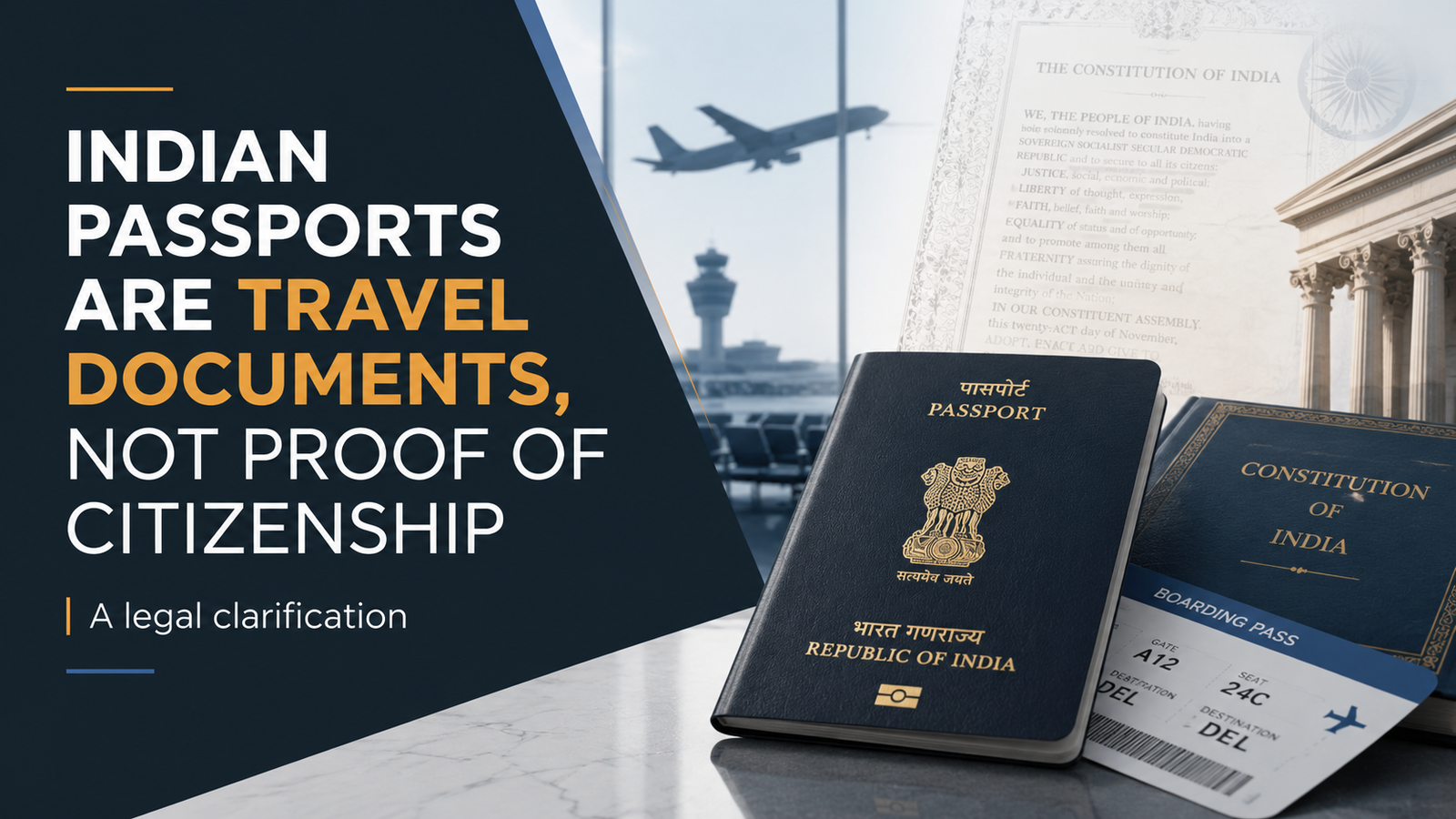
In India, the passport is widely regarded as a key identity document. Many citizens use it not only for travel but also as a proof of their nationality or citizenship. However, it is important to understand that legally, an Indian passport is primarily a travel document and not conclusive proof of Indian citizenship. This distinction matters in various legal and administrative contexts.
What Is an Indian Passport?
An Indian passport is issued by the Government of India through the Ministry of External Affairs. Its primary purpose is to enable Indian citizens to travel internationally and to seek consular assistance abroad. The passport contains personal details such as the holder's name, date of birth, photograph, and nationality.
Travel Document vs. Citizenship Proof
While the passport states the holder’s nationality as 'Indian,' it is not a legal document that establishes or proves citizenship. Instead, it is a travel document that certifies the holder’s identity and nationality for the purpose of crossing international borders.
Legal Perspective on Indian Passport and Citizenship
The Citizenship Act, 1955, and related laws govern the acquisition, determination, and proof of Indian citizenship. These laws specify who is a citizen of India based on birth, descent, registration, naturalization, or incorporation of territory.
According to legal interpretation, possession of an Indian passport does not automatically prove citizenship. For example, a person may hold a passport issued under certain circumstances but still have their citizenship status questioned or under review in legal or administrative proceedings.
Why This Matters
- In legal disputes or government procedures, citizenship must be established through proper documentation and legal processes, not solely by showing a passport.
- Passports can be issued to persons whose citizenship status is later changed or revoked, making the document insufficient alone to prove citizenship.
- For benefits, rights, or obligations linked to citizenship, authorities may require additional proof beyond the passport.
How Is Citizenship Proven Legally?
Indian citizenship can be proven through several documents and processes:
- Birth Certificate: For those born in India before or after certain dates, birth certificates can serve as evidence supporting citizenship claims.
- Citizenship Certificate: Issued by the government under the Citizenship Act, this is a formal proof of citizenship.
- Other Legal Documents: Such as registration certificates for overseas citizens or naturalization certificates.
Authorities may require these documents in combination with the passport when verifying citizenship for specific purposes.
What Should Passport Holders Know?
If you hold an Indian passport, it is important to remember:
- Your passport facilitates your international travel and identifies you as an Indian national abroad.
- It does not guarantee legal proof of citizenship in all administrative or legal contexts within India.
- For official matters requiring proof of citizenship, be prepared to provide additional documentation as per government requirements.
- In case of any doubt about your citizenship status, seek guidance from legal or government authorities.
Conclusion
Understanding the distinction between an Indian passport as a travel document and legal proof of citizenship is crucial for all Indian passport holders. While the passport plays an important role in international travel and identification, it is not a substitute for the legal documentation that establishes citizenship under Indian law.
Being aware of this difference can help individuals navigate administrative processes more effectively, avoid misunderstandings, and ensure they have the correct documents when citizenship proof is necessary.
"An Indian passport is a travel document and does not serve as conclusive proof of citizenship under Indian law." – Legal Interpretation